OpenSCAD, with No Install
OpenSCAD models are code: a .scad file describes a solid in a small functional language, and something has to evaluate it before there is geometry to view. KKSS evaluates .scad with a bundled OpenSCAD build (WebAssembly, Manifold backend) — since the 3.26.0 engine update there is nothing to install. A user-installed openscad binary stays as the fallback for the few constructs the bundled build declines. This walkthrough opens the downloadable example, drives it from the Customizer panel, meshes it, and shows where the fallback still matters.
The example file lives in /examples/openscad/:
| File | What it is |
|---|---|
bracket.scad | Source — a parametric L-bracket: base footprint, upright height, wall thickness, one mounting-hole diameter |
Copy bracket.scad into a scratch folder and follow along.
1. Open the model — nothing to install
Open bracket.scad in CAD mode — the file routes to the 🔷 Pre-Processing tab. The status line evaluates it in well under a second and the viewer shows a solid L-bracket, exactly as if an installed OpenSCAD had produced it: the bundled build emits the same .csg bytes the binary path produces, so opening, edits, BOM/hole-table/clash/health/measure, meshing and export all behave identically.
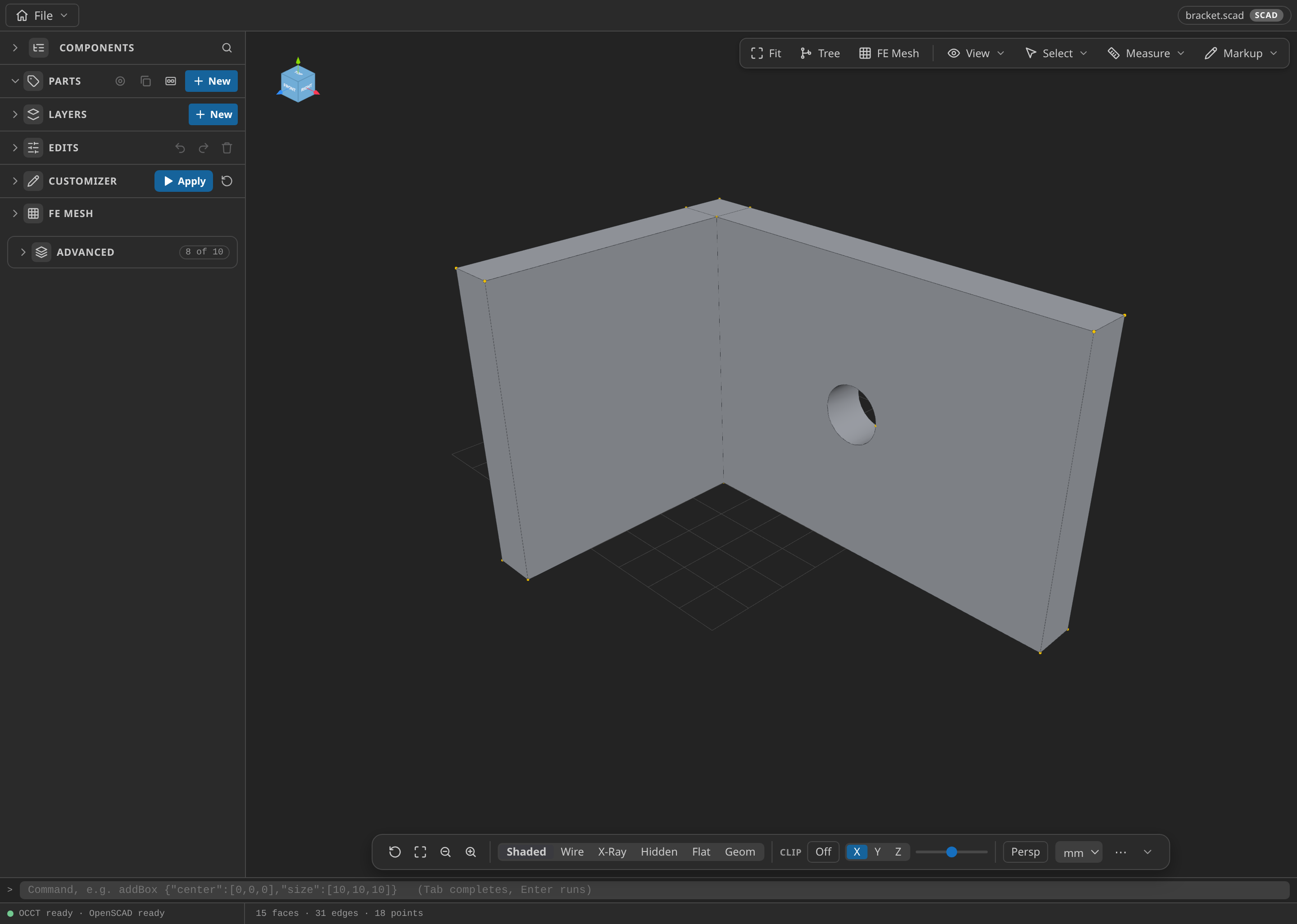
bracket.scad at its defaults: 60 × 40 mm base, 40 mm upright, 6 mm walls, an 8 mm hole.
Behind the scenes the conversion is WASM-first with binary fallback: the bundled build tries every .scad first, and only a model it declines — an import()/surface() of a local mesh, a missing include, more than 20 staged files or 1 MB of staged source — falls back to your installed binary (Settings ▸ Open Settings… ▸ CAD Viewer ▸ OpenSCAD Binary, or openscad on PATH). Any other failure (a syntax error, an empty model) is a genuine conversion failure and is reported, not retried.
2. Drive it from the Customizer
Fold open the Customizer panel (scad-panel): it lists the file's five parameters with their defaults and ranges, parsed from the source text alone — no evaluation needed. Set hole_d to 12 and press Apply. The panel persists the validated overrides to bracket.scad-params.json beside the source and replays them as -D defines on every later conversion: the hole grows, and reopening, every edit's re-tessellation, BOM, measuring, meshing and export all see the applied value. The .scad file itself is never written.
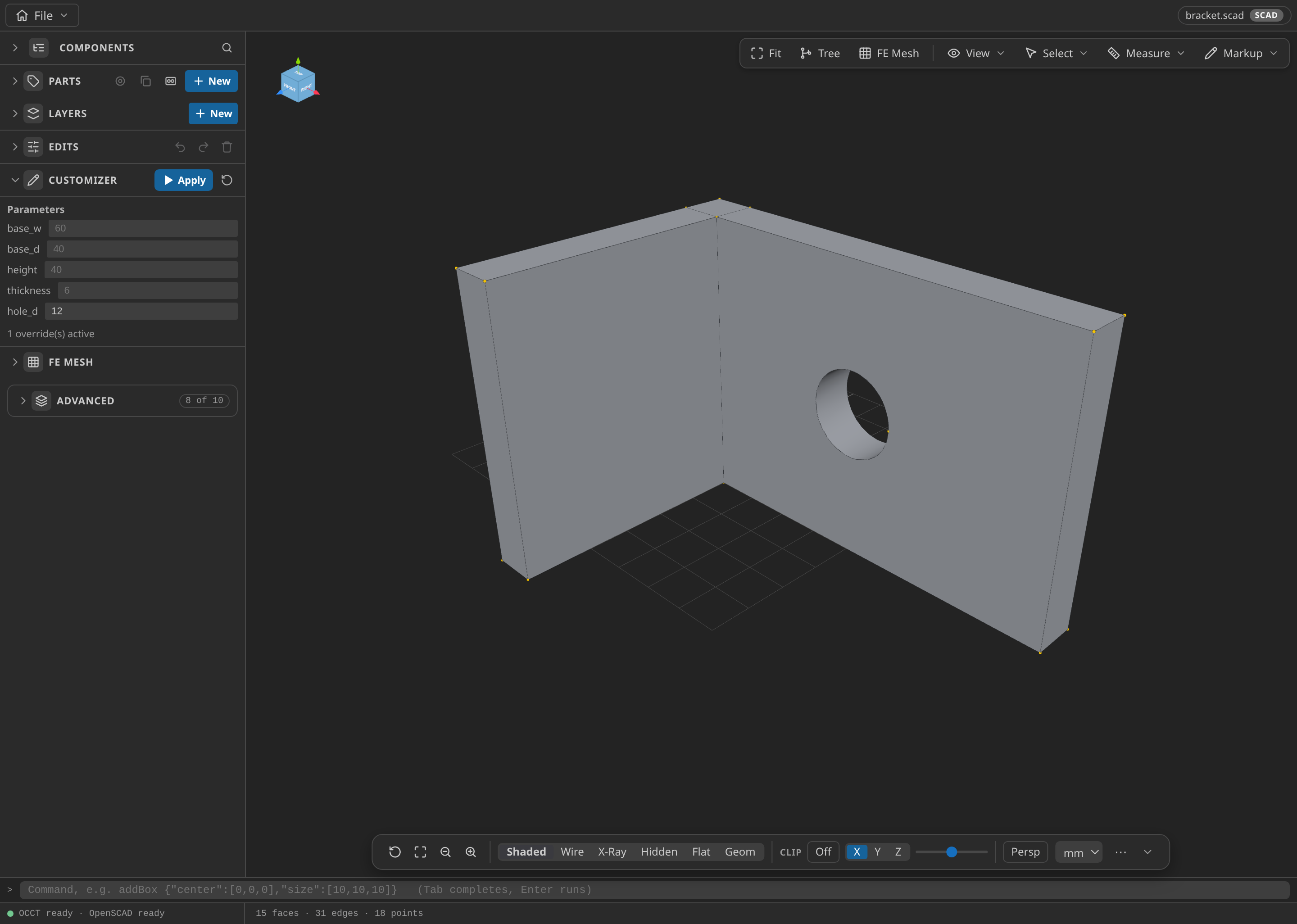
hole_d = 12 applied: the override lives in bracket.scad-params.json, replayed as -D hole_d=12.
Out-of-range numbers apply with a note (OpenSCAD itself does not clamp); unknown names and wrong types are dropped with a warning.
3. Mesh and export it like any solid
The evaluated bracket is a first-class solid: pick Parts, measure exact distances against the true geometry, and under FE Mesh generate like any STEP model. File ▸ Export… writes STEP/IGES/BREP or any mesh target — never back to .csg (both OpenSCAD formats are import-only).
4. The same thing through the assistant
The viewer and the cad__* tools share the conversion. Prompt:
List the Customizer parameters of /path/to/bracket.scad, then re-evaluate
it with hole_d=12 into /path/to/bracket-12.csg without touching the source.
list_scad_parameters reads the parameters from text alone; convert_scad re-evaluates with -D overrides, the configured backend and extra library folders, writing a new .csg. Both are WASM-first like the viewer, so neither needs an install.
5. When the fallback still matters
Two cases still want a real binary on PATH:
- Mesh imports. A model calling
import("gear.stl")orsurface()keeps the node for the binary path to resolve — the bundled build declines it in milliseconds and the binary takes over transparently. - Missing or out-of-tree includes. A
use/includethe staging cannot resolve (absent file, quoted include outside the source directory) declines the same way. OpenSCAD Library Folders prepends toOPENSCADPATHfor both paths, so ause <BOSL2/std.scad>resolves without copying libraries beside every model.
Without either path, opening a .scad reports that rather than failing silently. A large boolean tree is also worth knowing about: the bundled build's Manifold engine evaluates one far faster than the old CGAL default.