Pre-Processing (CAD) Mode
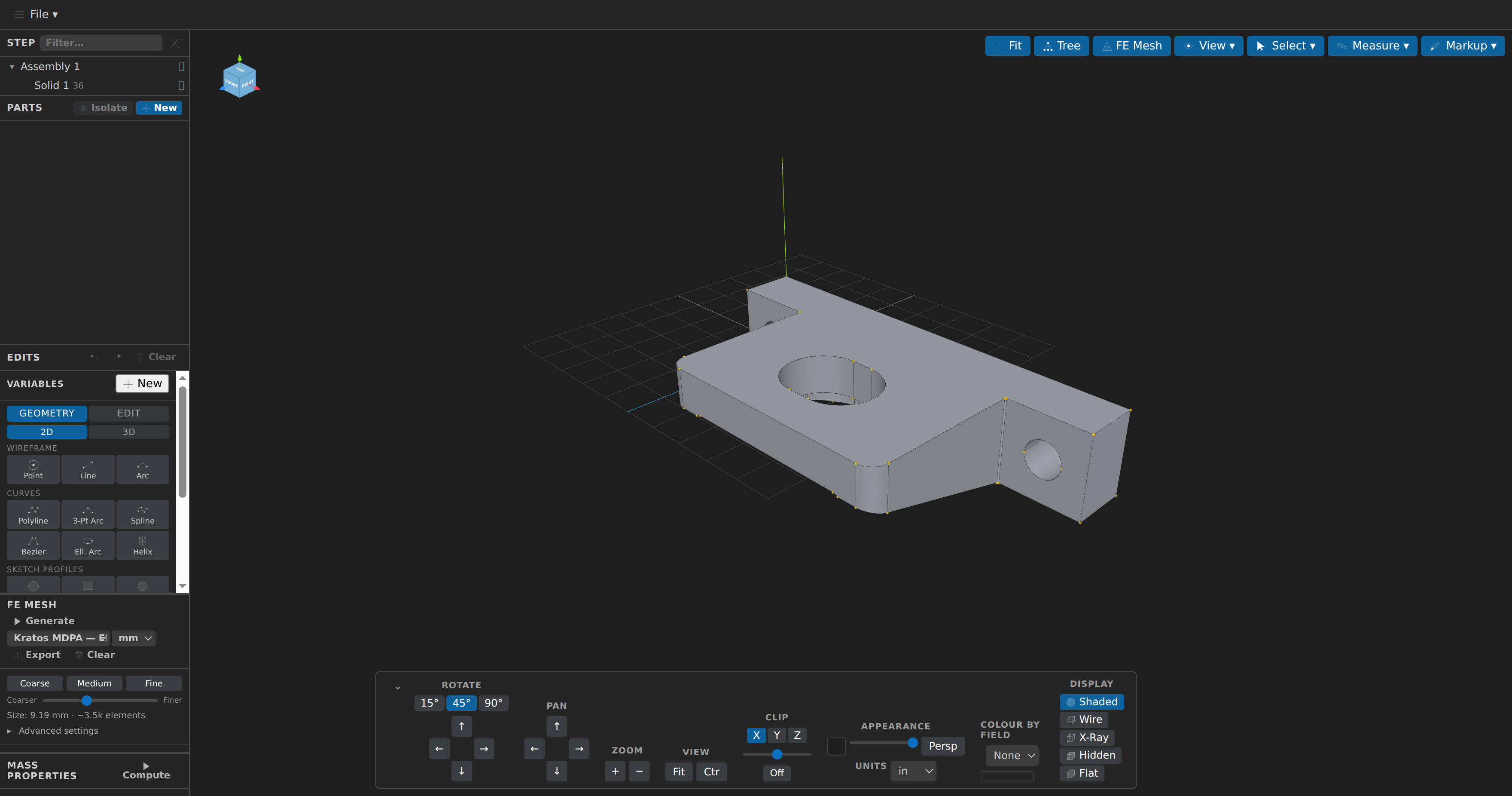
Pre-Processing mode embeds the full CAD-Preview viewer. Everything documented for the extension applies inside KKSS too — this page summarizes the highlights; see the CAD-Preview documentation for the complete feature guide.
What you can do
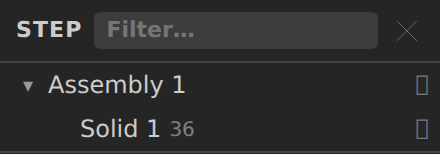
- View STEP, IGES, and BREP models (tessellated by OpenCascade in a background worker) and STL, OBJ, PLY, glTF/GLB meshes (loaded natively by Three.js), with orbit/pan/zoom, an orientation cube, five display modes (Shaded, Wireframe, X-Ray, Hidden Lines, Flat), a capped clipping plane, an exploded-view slider, background/opacity controls, an orthographic/perspective toggle, and a searchable component tree with per-part isolate/hide. A STEP or IGES file's declared length unit is detected and preselected.
- Import mesh-only formats: VTK/VTU, MED, CGNS, Exodus, XDMF and Kratos MDPA open as a boundary surface through meshio++, with named regions turned into Parts and any scalar point/cell field usable to colour the model. Geometry only — for fields, blocks and SubModelParts, open the file in Post-Processing instead (which is where a double-click lands it).
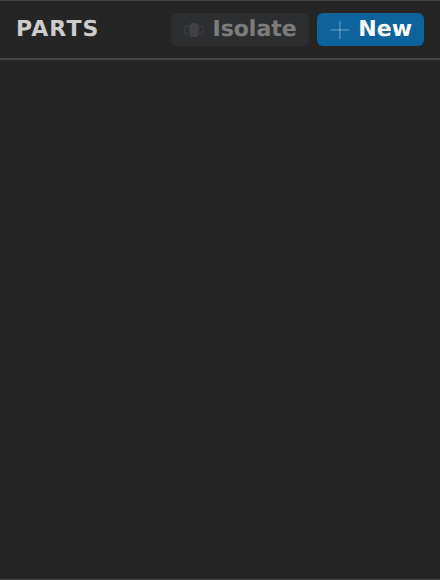
- Define parts: pick volumes, surfaces, lines, or points and group them into named parts (Kratos sub-model-parts). Assignments persist to a
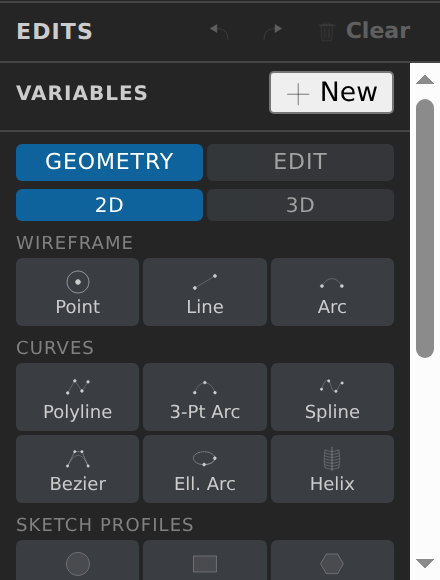
<model>.parts.jsonsidecar — the CAD file is never modified. After a topology-changing edit, part assignments are geometrically rebound to the renumbered entities instead of being silently lost. - Edit geometry parametrically: transforms, booleans, fillets/chamfers, feature modeling (extrude/revolve/sweep/loft), primitives, 2D sketches, bottom-up wireframe modeling, and named variables with expressions. The ordered op-list persists to
<model>.edits.jsonand replays on every open. - Measure and inspect: distance, edge length, angle and radius as a live overlay, each with an ⟟ Exact button that recomputes against the true OCCT geometry instead of the triangulation; a measurement can be pinned to the model so it persists across sessions. Plus a Mass Properties panel (volume, surface area, centre of mass, moments of inertia) for the whole model or one entity.
- Keep your place: the camera, display mode, projection and clip plane are saved per document, and the components tree reads a STEP file's real XCAF assembly structure. Edits replay from a cached parse, so an interactive change re-tessellates in a fraction of the original load time. Sidecars and the source are watched, so an external change reloads in place.
- Annotate: freehand, line, arrow, rectangle and circle markup drawn over the 3D view, with undo/redo and an eraser, baked into screenshots.
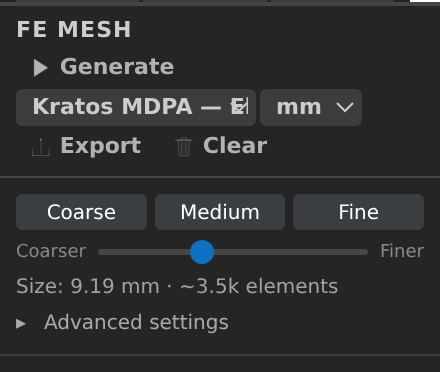
- Generate FE meshes with Gmsh (WASM): size controls, element shape (tets/hexes/hex-dominant) and order (linear/quadratic), per-part mesh sizes, physical groups from your parts, a live mesh overlay, and a quality summary with the worst elements highlighted through the model.
- Export: STEP/IGES/BREP (via OCCT), STL/OBJ/PLY/glTF (via Three.js), and FE meshes to Kratos MDPA, Gmsh
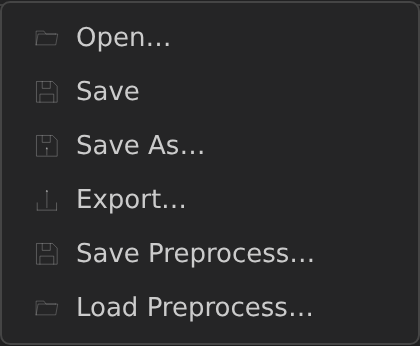
.msh, VTK, UNV, Abaqus, Nastran, SU2, MED, CGNS, XDMF, and more — each optionally unit-converted (mm/cm/m/in/ft) on the way out. File ▸ Screenshot… (Ctrl+Alt+P) saves the current view as a PNG.
| Components tree | File menu | FE Mesh panel |
|---|---|---|
 |  |  |
The toolbar is Fit · Tree · FE Mesh plus four dropdowns — View ▾ (Grid, Edges, Screenshot), Select ▾ (selection mode + Point/Vol/Surf/Line), Measure ▾ and Markup ▾ — with the display modes, clip, appearance and unit controls in the view-controls panel.
Viewer defaults
Settings ▸ CAD Viewer Defaults seeds a newly opened document: Up Axis (Y or Z), Default Mesh Size (Coarse/Medium/Fine), Tessellation Quality (Draft/Standard/Fine — how finely a B-rep is triangulated, traded against load time) and Show Grid & Axes on Open. They are only the starting point — a per-document <model>.mesh.json or <model>.view.json value, or a runtime toggle in the view controls, always wins once set. Tessellation quality is re-read on every B-rep load, so a change applies at the next edit or reopen.
| Edits panel | Parts panel | View controls |
|---|---|---|
 |  |  |
Sidecar files
Pre-Processing mode never writes your CAD file. State lives beside it:
| File | Contents |
|---|---|
<model>.parts.json | Part definitions (entity ids, colors, mesh sizes) |
<model>.edits.json | Replayable edit operations + parametric variables |
<model>.annotations.json | Pinned measurements |
<model>.view.json | Camera, display mode, projection, clip plane |
<model>.mesh.json | Gmsh meshing options |
<model>.geo | Generated Gmsh script (one-way; regenerated on change) |
Save (Ctrl+S) flushes all sidecars immediately; otherwise they autosave half a second after each change.
File ▸ Save Preprocess… bundles the CAD source and whichever sidecars exist into a single .zip, and Load Preprocess… restores one next to a destination you pick and opens it. The archive carries a manifest with a SHA-256 per entry, so a tampered or truncated file is rejected rather than half-restored; the reader also refuses entries that decompress far beyond their stored size. The .geo script is deliberately not packed — it is regenerated from the restored mesh options.