Getting Started
KKSS (Keep Kratos Simple Stupid) is a desktop application for preparing and inspecting Kratos Multiphysics simulation models. It bundles two proven viewers — the CAD-Preview and VSCode-MDPA-Preview VS Code extensions — into one window with a mode toggle.
Installation
Grab the installer for your platform and architecture from the download page (built for every release tag by CI):
| Platform | Architectures | Artifact |
|---|---|---|
| Linux | x86-64, ARM 64 | .AppImage (portable) or .deb |
| Windows | x86-64, ARM 64 | NSIS .exe installer |
| macOS | Apple Silicon (ARM 64) | .dmg / .zip |
macOS Gatekeeper
Release builds are currently unsigned. On macOS, right-click the app and choose Open the first time to bypass Gatekeeper.
The home screen
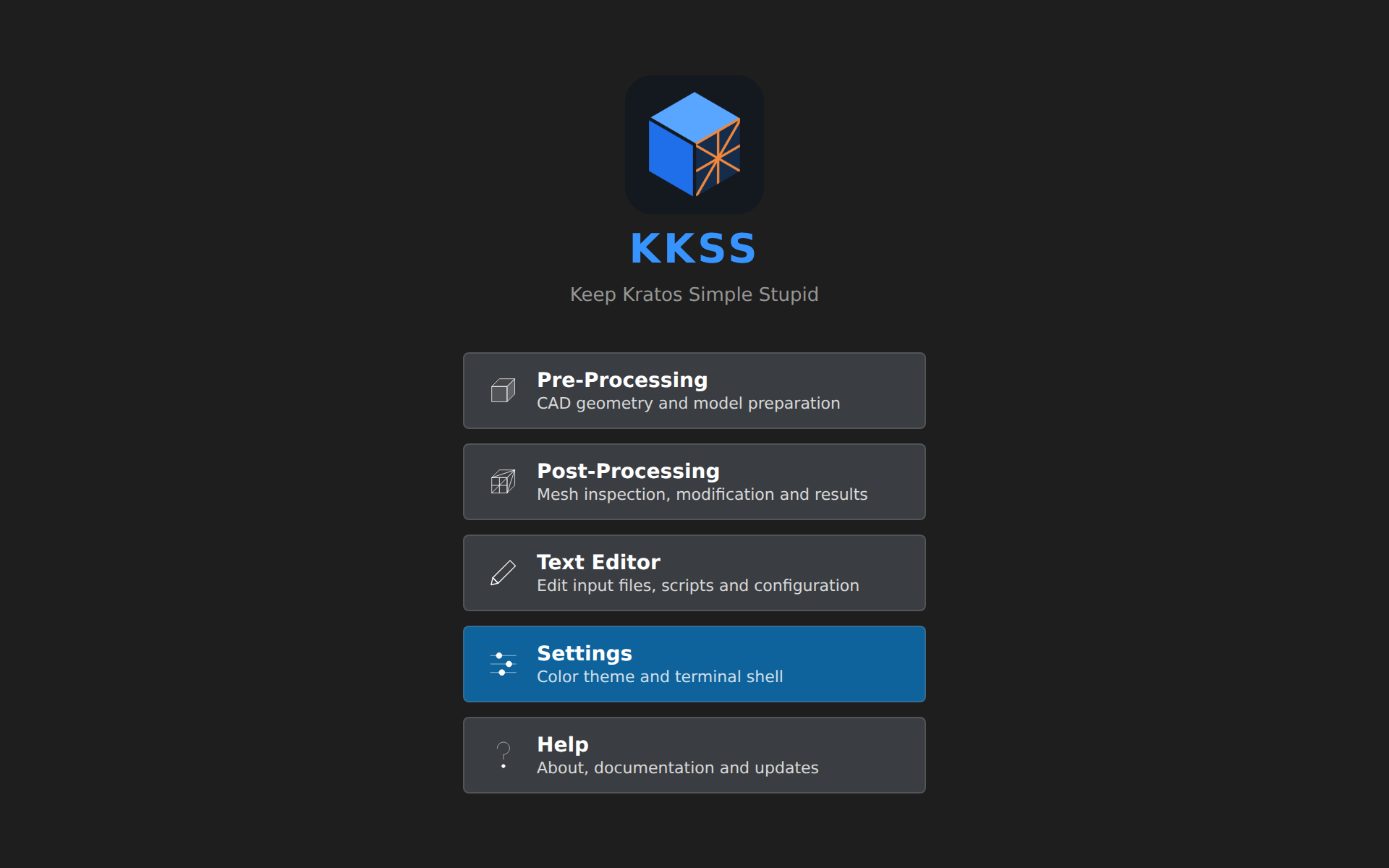
KKSS opens on a main menu with one button per task — Pre-Processing, Post-Processing, and Help. Pick a mode to enter it; the Home button in the toolbar (or Ctrl+0 / View ▸ Home) brings the menu back at any time without losing what's loaded in either mode.
The two modes
The toolbar at the top of the window holds the mode toggle:

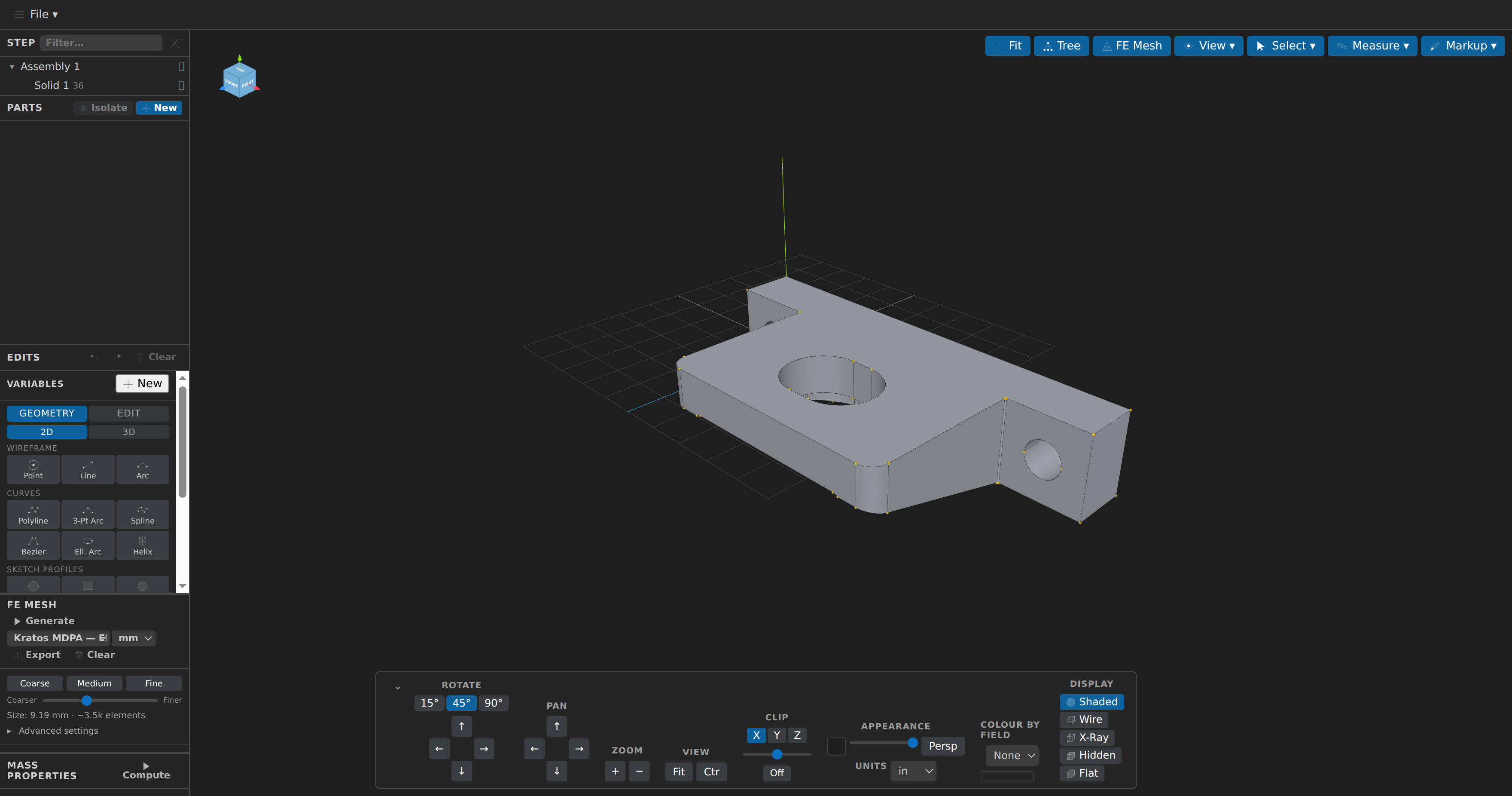
- 🔷 Pre-Processing — CAD geometry and model preparation (details). Opens STEP, IGES, BREP, STL, OBJ, PLY, and glTF.
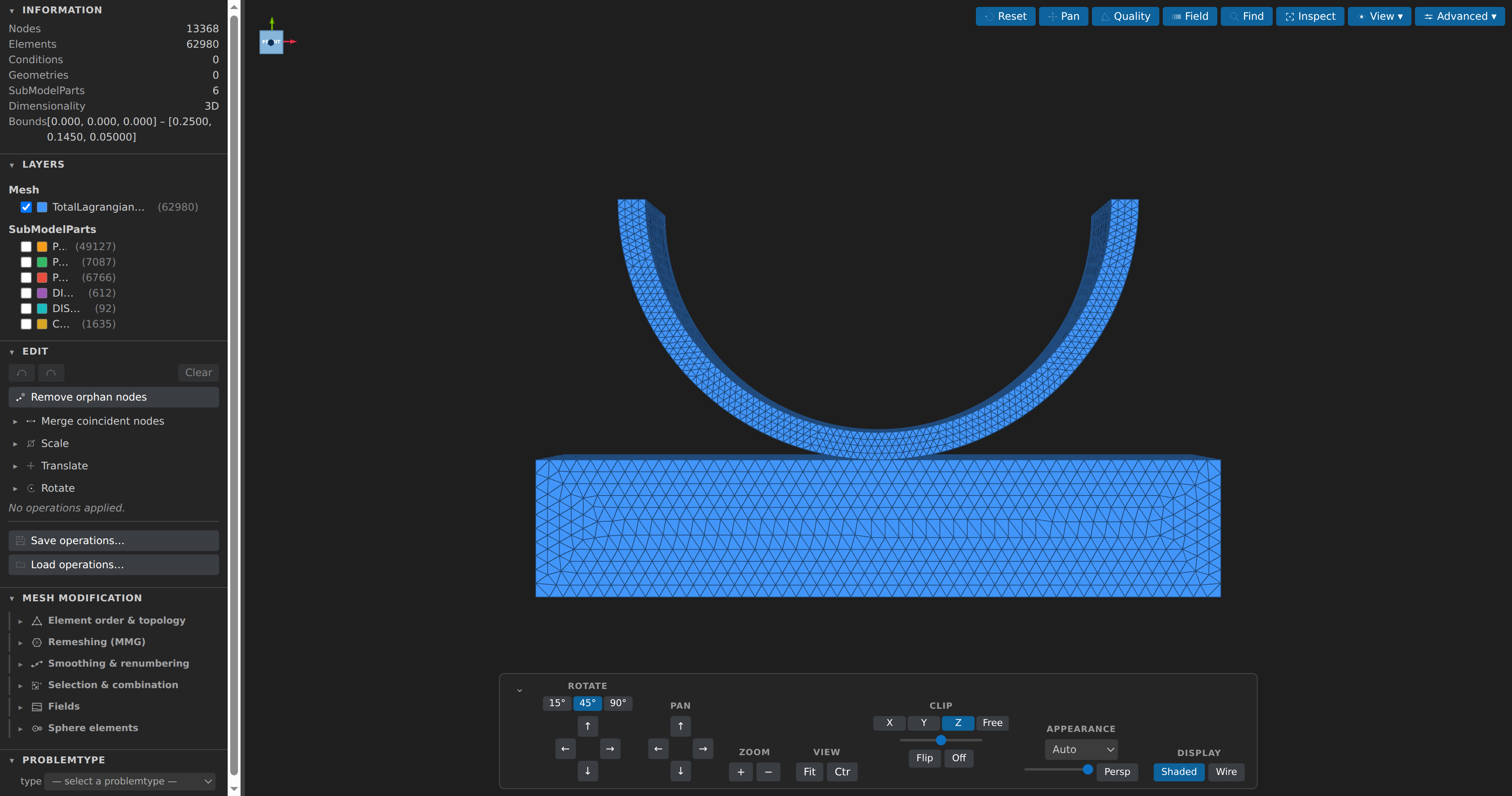
- 🔶 Post-Processing — mesh inspection, modification, and result visualization (details). Opens MDPA, VTK (legacy + XML), STL, OBJ, PLY, and 39 extended mesh formats via meshio++ (Gmsh, Abaqus, Nastran, UNV, Medit, Netgen, SU2, XDMF, Exodus, CGNS, MED, EnSight Gold, Triangle, …). Result fields render as combinable contour/isosurface/quiver/deformed-shape modes, and an Advanced toolbar menu holds the Mesh Size panel (nodal/element size statistics), sphere glyphs for particle meshes, face normals for spotting inverted elements, and boundary-skin export.
Both mode views stay alive when you switch: the loaded file, the camera, and your undo history are all preserved.
The toolbar also has an interface-scale picker on the right (75 %–150 %) for adjusting how large the whole app appears — useful on high-DPI or low-resolution displays. It scales every part of the window (toolbar, viewers, terminal, chat) together, is remembered across launches, and can also be driven from the keyboard: Ctrl + / Ctrl - step through the sizes and Ctrl+Shift+0 resets to 100 % (also under View ▸ Zoom In / Zoom Out / Reset Zoom).
| 🔷 Pre-Processing | 🔶 Post-Processing |
|---|---|
 |  |
About & updates
Help on the home screen (or Help ▸ About KKSS…) shows the app version and checks GitHub for a newer release. When an update exists, Update now downloads and installs it in place on Windows and on the Linux AppImage — restart when prompted. .deb and macOS installs instead get a button to the releases page (those package types can't self-update; macOS builds are unsigned). No network? The dialog still shows your version and offers a Retry.
After an update, the next launch automatically pops up a What's New window listing what changed since the version you last ran — no popup on a first install, and it only ever shows entries newer than what you'd already seen. Dismiss it with Got it (or Esc); reopen the full history any time from Help ▸ What's New….
Embedded terminal
The Terminal toolbar button (or Ctrl+` / View ▸ Toggle Terminal) opens a shell panel below the viewer — handy for launching Kratos runs (python MainKratos.py) while watching the model. The session starts in the current file's directory, runs PowerShell on Windows and your $SHELL on macOS/Linux (changeable under Settings ▸ Terminal Shell), keeps running while hidden (hide it with the ✕ Hide button in the panel's corner, the toolbar button, or Ctrl+` ), and offers a restart when the shell exits. The panel is shared by both modes; its height is fixed in this version.
AI assistant
The Chat toolbar button (or Ctrl+Shift+L / View ▸ Toggle AI Chat) opens a chat sidebar on the right where an LLM can drive KKSS for you: load and edit CAD models, define sub-model-parts, generate and export meshes, inspect and transform MDPA/VTK files, set up Kratos cases, and run simulations. The assistant works through the same tool servers (MCP) that power the two viewers plus the standalone kratos-mcp-server; the three dots in the sidebar header show each server's status (green = ready, red = unavailable — hover for details). The first two ship with KKSS; the Kratos one is fetched with uvx and is simply marked unavailable if uv isn't installed.
Before first use, pick a provider and set an API key under Settings ▸ LLM Assistant:
- Anthropic (Claude) — the default; set Anthropic API Key (and optionally the model, default
claude-opus-4-8). - OpenAI-compatible — any
chat/completionsbackend: set the Base URL (e.g.https://api.openai.com/v1orhttp://localhost:11434/v1for Ollama), the model name, and a key if the backend needs one.
Keys are stored encrypted with your OS keychain when available. Edits made by the assistant land in the same sidecar files the viewers use — reload the file to see them. Send with Enter, stop a running response with the same button, and start over with ⟳ New.
Use your own MCP client
If you'd rather drive KKSS from an external LLM client (Claude Code, GitHub Copilot, Claude Desktop, another agent) than the built-in sidebar, enable Settings ▸ MCP Server. KKSS then serves the same unified cad + mesh + Kratos toolset — plus the Kratos worked-example resources and guided prompts — over a localhost Streamable HTTP MCP endpoint. Use Copy Address & Token… to grab the http://127.0.0.1:<port>/mcp URL and its bearer token (default port 7391). It is off by default and bound to localhost only; the token gates access because these tools read and write files on disk — Regenerate Token… rotates it (update your clients afterwards). Change the port under the same menu (toggle the server off and on to rebind). Tools arrive namespaced cad__* / mesh__* / kratos__*; the Kratos worked examples show up as MCP resources and prompts.
Leave KKSS running with the server enabled, then point a client at it:
Claude Code — register it as an HTTP server (repeat --header for the token):
claude mcp add --transport http kkss http://127.0.0.1:7391/mcp \
  --header "Authorization: Bearer <token>"
Run /mcp inside Claude Code to confirm kkss is connected and list its tools. Remove it later with claude mcp remove kkss.
GitHub Copilot (VS Code) — add an HTTP server entry to .vscode/mcp.json in your workspace (or run MCP: Add Server… from the Command Palette). Using an input keeps the token out of the file — VS Code prompts for it once and stores it securely:
{
  "inputs": [
    { "id": "kkss-token", "type": "promptString", "description": "KKSS MCP token", "password": true }
  ],
  "servers": {
    "kkss": {
      "type": "http",
      "url": "http://127.0.0.1:7391/mcp",
      "headers": { "Authorization": "Bearer ${input:kkss-token}" }
    }
  }
}
Click Start on the server in mcp.json, then open Copilot Chat in Agent mode and enable the kkss tools from the tools (🛠) picker.
Any MCP client that speaks Streamable HTTP with a bearer header works the same way — give it the URL and the Authorization: Bearer <token> header.
Text editor
The Edit toolbar button opens the file currently loaded in the active mode (.mdpa, .stp, …) as plain text — handy for touching up an input deck without leaving the app. Text Editor on the home screen (or File ▸ Open in Text Editor…) opens any file via a dialog instead. It's a lightweight editor for input files, scripts and configuration — .json and .py get syntax highlighting; binary or very large files are refused with a notice. Ctrl+S saves, Ctrl+Shift+S saves as, and the toolbar has Open/Save/Save As buttons. Unsaved changes show a ● next to the file name; switching screens never loses the buffer, and closing the window with unsaved changes prompts to save. Pair it with the terminal panel (Ctrl+` ) to edit and launch a Kratos case side by side.
Settings
The Settings menu (also reachable from the home screen's Settings button) holds app-level preferences, persisted across runs:
- Color Theme — Auto / Dark / Light / Scientific. The same scene theme the mesh viewer's own picker controls; viewers apply it when they next load a file.
- CAD Viewer Defaults — up axis, default mesh-size preset, B-rep tessellation quality, and whether the grid and axes show on open. These seed a newly opened CAD document; a per-document sidecar value or a runtime toggle wins once set.
- Terminal Shell — the shell the embedded terminal launches (takes effect for the next terminal session).
- LLM Assistant — provider (Anthropic / OpenAI-compatible), API keys, model names, and the OpenAI-compatible base URL for the AI chat sidebar. Keys are encrypted with the OS keychain (Electron
safeStorage) when one is available; changes apply to the next message, no restart needed. - MCP Server — enable the localhost HTTP endpoint that exposes KKSS's toolset to an external MCP client, set its port, and copy or regenerate the bearer token (see AI assistant ▸ Use your own MCP client above). Off by default.
Viewer actions (mesh quality, field visualization, find entity…) are not in the menu bar — they live in each viewer's own toolbar.
Opening files
- Open… button or
Ctrl+O— opens a file in the current mode, replacing whatever the focused tab currently shows. - File ▸ Open in the CAD viewer's own File menu — same thing. (The mesh viewer's in-view File menu is hidden; use the app's File menu, which covers the same actions plus Save/Load Problem.)
- Formats supported by both modes (
.stl,.obj,.ply) open in whichever mode is currently active. - Mesh formats Pre-Processing can also import (
.mdpa,.vtk,.vtu,.med,.cgns,.exo,.xdmf) always open in Post-Processing, which reads them natively. Use Pre-Processing's own Open dialog when you want the geometry-only CAD import instead.
Tabs — several open documents at once
Each mode (Pre-Processing and Post-Processing) shows a row of tabs below the toolbar, one per open document. Click + at the end of the strip, or File ▸ New CAD Tab / New Mesh Tab, to open a second document alongside the first — each tab keeps its own camera position, edit history, and (in Post-Processing) its own Flowgraph session, completely independent of the others. Click a tab to switch to it; click its ✕ to close it (closing needs no confirmation — nothing about tabs is unsaved in the way a text buffer can be, since both viewers autosave their sidecars). A mesh exported from a Pre-Processing tab (File ▸ Export… to .mdpa/.vtk/…) opens in a new Post-Processing tab rather than replacing whatever you're currently viewing there.
Keyboard shortcuts
| Shortcut | Action |
|---|---|
Ctrl+O | Open a file into the focused tab of the active mode |
Ctrl+W | Close the focused tab |
Ctrl+S | Save (CAD: flush sidecars · Mesh: overwrite the source file) |
Ctrl+Shift+S | Save As |
Ctrl+E | Export |
Ctrl+Alt+S / Ctrl+Alt+O | Save / Load a problem archive (Post-Processing) |
Ctrl+Alt+P | Screenshot the current view to PNG |
Ctrl+0 | Back to the home screen (main menu) |
Ctrl+1 / Ctrl+2 | Switch to Pre-Processing / Post-Processing |
Ctrl+` | Toggle the embedded terminal |
Ctrl+Shift+L | Toggle the AI chat sidebar |
On macOS use Cmd instead of Ctrl.
Inside the mesh view, 1–6 snap the camera to ±X/±Y/±Z and i to an isometric view.