
C++ mesh backends
The C++ core has three interchangeable in-memory mesh backends, selected at build time with the CMake option MESHIOPLUSPLUS_MESH_BACKEND (exactly one is compiled per build, like the parallel backend):
| Backend | Structure | Use it for |
|---|---|---|
MESHIO (default) | Mesh/CellBlock over dtype-erased NDArrays, mirroring the Python meshio.Mesh | The Python extension (required for it — PyPI wheels always use MESHIO) |
NATIVE | Canonical statically-typed storage: Float64 points, Int64 connectivity, CellType enum, CSR ragged blocks | The fastest pure-C++ consumer surface; the WebAssembly build uses it |
KRATOS | A Kratos Multiphysics-style ModelPart (Nodes / Elements / Conditions / SubModelParts) | Near-costless exchange with Kratos (or CoSimIO) via the header-only bridge |
# standalone C++ build with a non-default backend (implies no Python extension)
./build/configure.sh --mesh-backend NATIVE --tests --build
./build/configure.sh --mesh-backend KRATOS --tests --build
Every format reader/writer is written against a uniform mesh API (src/cpp/include/meshioplusplus/mesh_api.hpp), so all 79 core formats compile and round-trip identically under every backend — the full GoogleTest suite runs per backend in CI. Selecting NATIVE/KRATOS together with MESHIOPLUSPLUS_BUILD_PYTHON=ON is a CMake configure error: the zero-copy numpy boundary is written against MESHIO's exact struct layout.
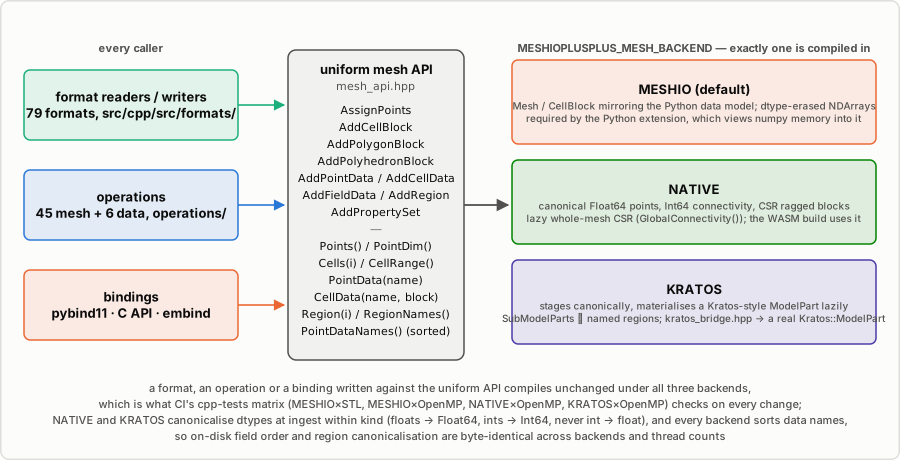
The uniform mesh API
meshioplusplus::Mesh is a compile-time alias (src/cpp/include/meshioplusplus/mesh.hpp) for the selected backend type. All backends implement:
Ingestion (what readers use — NDArray is the universal staging type, handed over by move):
mesh.AssignPoints(NDArray points);                    // (n, dim), float dtype
mesh.AddCellBlock("tetra", NDArray conn);             // (n, npc), integer dtype
mesh.AddPolygonBlock("polygon", rows);                // 1-level ragged, nested-vector form
mesh.AddPolyhedronBlock("polyhedron", cells);         // 2-level ragged, nested-vector form
// CSR overloads move the flat arrays in with no per-cell/per-face allocation;
// every mesh backend stores ragged blocks this way, MESHIO included since v16.16.0:
mesh.AddPolygonBlock("polygon", nodes, face_offsets);
mesh.AddPolyhedronBlock("polyhedron", nodes, face_offsets, cell_offsets);
mesh.AddPointData("temperature", NDArray data);
mesh.AddCellData("gmsh:physical", std::vector<NDArray> perBlock);
mesh.AppendCellData("medit:ref", NDArray oneBlock);   // incremental variant
mesh.AddFieldData("group", NDArray data);
Accessors (what writers use):
mesh.NumPoints();  mesh.PointDim();  mesh.Points();   // const NDArray&
mesh.NumCellBlocks();
for (const auto cb : mesh.CellRange()) {              // Mesh::CellView values
    cb.Type();          // "tetra", ...
    cb.NumCells();  cb.NodesPerCell();  cb.Conn();    // const NDArray&
    cb.IsRagged();  cb.Row(i);  cb.Face(i, f);        // ragged access
}
mesh.PointDataNames();                                // always sorted
mesh.PointData("temperature");                        // const NDArray&
mesh.CellData("gmsh:physical", blockIndex);
Dtype rules: MESHIO stores arrays exactly as received; NATIVE and KRATOS canonicalize within kind (floats → Float64, ints → Int64 — an integer tag array never becomes float, so "first integer cell_data is the tag" format conventions survive). Owning arrays that are already canonical are moved, not copied, and readers produce canonical dtypes almost everywhere, so ingest is near-free. One observable consequence: under NATIVE/KRATOS, a file with Float32 points is re-written as Float64.
The NATIVE backend
meshioplusplus::NativeMesh (backends/native_mesh.hpp) adds a fast-consumer surface on top of the uniform API:
const double* xyz = mesh.PointsData();                    // contiguous Float64
std::span<const std::int64_t> conn = mesh.ConnSpan(0);    // per-block Int64
meshioplusplus::CellType t = mesh.BlockType(0);           // enum, not string
const auto& csr = mesh.GlobalConnectivity();              // whole-mesh CSR
// csr.mOffsets (ncells+1), csr.mConn (flat), csr.mTypes (one per cell)
Ragged blocks are stored CSR-style (flat node buffer + offset arrays) rather than nested vectors — this is not NATIVE's own trick: since v16.16.0 MESHIO stores them the same way (it held nested vectors before). GlobalConnectivity() is built lazily and cached. See polyhedra and ragged cells for the CSR array layout itself.
The KRATOS backend
meshioplusplus::KratosMesh (backends/kratos_mesh.hpp) puts a Kratos-style ModelPart behind the same API:
meshioplusplus::Mesh mesh = meshioplusplus::read_gmsh("part.msh");
meshioplusplus::ModelPart& mp = mesh.GetModelPart();   // materialized lazily
mp.NumberOfNodes();       // Ids are 1-based (node Id = point index + 1)
mp.NumberOfElements();    // cell blocks of the mesh's max topological dim
mp.NumberOfConditions();  // lower-dimension blocks
mp.GetSubModelPart("gmsh_physical_1"); // built from integer tag arrays- Elements vs Conditions: blocks whose topological dimension equals the mesh's maximum become Elements, lower-dimension blocks Conditions (the Kratos convention, matching the mdpa reader/writer), each kind Id-numbered 1..N in block order with default Kratos names (
Element3D4N,SurfaceCondition3D3N, ... —backends/kratos_names.hpp). - Tags → SubModelParts: integer cell-data under well-known names (
gmsh:physical,su2:tag,medit:ref,cell_tags, ...) automatically become SubModelParts named<key>_<value>containing the tagged entities and their nodes. Disable withmesh.SetBuildSubModelPartsFromTags(false)before the firstGetModelPart()call. The tag arrays also stay as elemental/conditional data, so writer round-trips are byte-identical.
Since v9.2.0 the pass can also be narrowed per key, which matters for .mdpa: a Kratos properties id is read as a gmsh:physical cell tag, so a deck with one sub model part comes back with gmsh_physical_0 beside it — material assignment surfacing as a group. For a genuine gmsh file that same inference is wanted, so the key stays in the table and the consumer says which meaning applies:
mesh.ExcludeTagSubModelPartKey("gmsh:physical");   // everything else still applies
mesh.SetTagSubModelPartKeys({"cell_tags"});        // ...or an explicit allow-list
mesh.TagSubModelPartKeys();                        // the effective set
An empty allow-list restores the default. Both setters re-materialize, so they may be called after GetModelPart().
- Property sets →
Properties(v9.2.0):Begin Propertiesbodies read from a.mdparide on the mesh (AddPropertySet/GetPropertySet) and materialize asModelPart::Propertiesblocks with real values, not just ids — which is what makesto_model_part's "apply property" overload transfer material data. They are keyed by id rather than by entity index, so no operation ever has to remap them; shape-preserving operations (clean,smooth,transform,attach_quality, the data ops) carry them through, while restructuring and multi-input ones (merge,crop,split,partition) do not. - point/cell data become simplified per-entity variables (
mp.GetNodalData("temperature"),mp.GetElementalData(...),mp.GetNodalValue("temperature", nodeId)). - Lazy and write-transparent: a plain read → write conversion never builds the ModelPart at all; writer accessors serve from the canonical staging storage, so output matches the NATIVE backend byte-for-byte.
- Mutation: after changing the ModelPart directly (
CreateNewNode, ...), callmesh.InvalidateBlocks(); the block view is then rebuilt from the ModelPart (consecutive same-type Elements group into blocks, then Conditions). Ragged pass-through blocks (polygon/polyhedron — Kratos has no such geometry) and SubModelPart structure are not representable back and are dropped by that rebuild.
The Kratos bridge (works from any backend)
src/cpp/include/meshioplusplus/kratos_bridge.hpp is header-only, templated, and independent of the selected mesh backend — meshioplusplus::ModelPart and the bridge compile in every build. to_model_part populates any Kratos-like class through the narrow creation API only (CreateNewNode/CreateNewElement(name, id, nodeIds, properties)/...), so it works with a real Kratos::ModelPart without meshio++ ever linking Kratos:
#include "meshioplusplus/kratos_bridge.hpp"

// Real Kratos: map properties ids to Properties::Pointer.
Kratos::ModelPart& dest = model.CreateModelPart("FromMeshio");
meshioplusplus::to_model_part(mesh.GetModelPart(), dest, [&](auto pid) {
    return dest.HasProperties(pid) ? dest.pGetProperties(pid)
                                   : dest.CreateNewProperties(pid);
});

// And back (duck-typed via bridge_traits; specialize it for classes whose
// accessors differ from meshioplusplus::ModelPart's shape):
meshioplusplus::ModelPart mine = meshioplusplus::from_model_part(source);
Sub model parts (including nested ones) are copied when the destination supports CreateSubModelPart/AddNodes/AddElements/AddConditions. CoSimIO's ModelPart (whose CreateNewElement takes an ElementType enum) is populated with a thin loop instead — CI compile-checks that pattern against the real CoSimIO headers on every run. The conversion cost is one O(n) bulk-create pass — the same cost Kratos's own CoSimIO conversion utilities pay, because Kratos's pointer-based entity storage cannot be aliased from outside.
Benchmarks between backends
benchmark/bench_backends.sh builds one benchmark binary per backend (src/cpp/benchmark/bench_backends.cpp, CMake option MESHIOPLUSPLUS_BUILD_BENCHMARKS=ON) and collates a CSV comparing ingest, accessor traversal, ModelPart materialization (KRATOS only), and full file round-trips on a synthetic tet cube. See Benchmarks for results and method.
Adding a backend
One CMake branch defining MESHIOPLUSPLUS_MESH_BACKEND_<NAME>, one #elif in src/cpp/include/meshioplusplus/mesh.hpp, and a backends/<name>_mesh.hpp implementing the uniform API (mesh_api.hpp documents the exact contract; tests/cpp/test_mesh_api.cpp is its executable form and must pass).
Kratos entity names, properties and nesting (v9.1.0)
Three things a Kratos consumer needs that used to be lost on the way through.
Entity names. GeometricalEntity carries an optional Kratos registration name (Name()/HasName()); empty means "derive it from the cell type", which is what every caller got before. It matters because deriving is lossy in one direction only: SmallDisplacementElement3D4N resolves to Tetrahedra4, but Tetrahedra4 only ever derives back to the canonical Element3D4N.
Names are stored as interned const std::string* from a root-owned detail::NamePool, not owned strings: there is one distinct name per block but one entity per cell, so an owned string would add ~320 MB to a 10 M-element model part. std::unordered_set is node-based, so the pointers survive both rehashing and a ModelPart move.
On the mesh backend they ride per block:
meshioplusplus::MdpaInfo info;
Mesh m = meshioplusplus::read_mdpa(path, info);
for (std::size_t b = 0; b < m.NumCellBlocks(); ++b)
    m.SetBlockEntityName(b, info.mEntityNames[b].mName);
ModelPart& r_mp = m.GetModelPart(); // entities now carry the real namesSetBlockEntityName/BlockEntityName are KRATOS-only extras, not part of the uniform mesh API — no other backend has a ModelPart to spell names for. This is the same "fast-consumer surface" shape as NATIVE's PointsData()/ConnSpan().
Properties. ModelPart has a real Properties store (CreateNewProperties/GetProperties/Properties()), and Materialize() reads each entity's properties id from the gmsh:physical cell_data instead of leaving every entity on properties 0. The values are PropertyValue key/value pairs (meshioplusplus/properties.hpp), shared with MDPA so there is one representation. Turning them into typed Kratos Variable<T>s is the consumer's job — see the applier overload in doc/cpp_api.md.
Nesting. SubModelPart nesting now survives the staging round trip, flattened into region names with / — see doc/regions.md.